Blog
How to Source Personalized Jewelry for Women Worldwide?
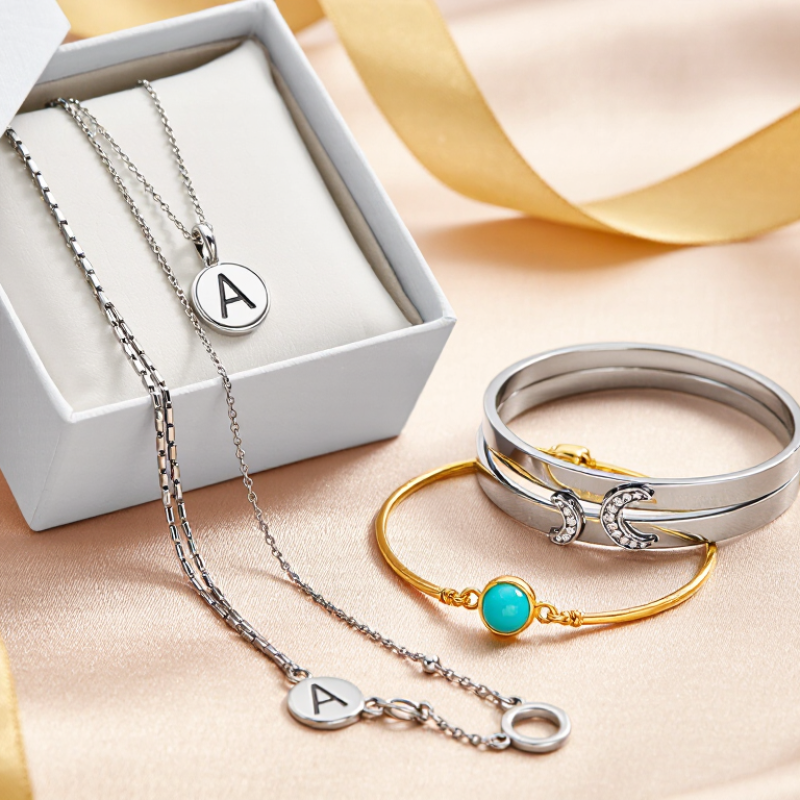
Sourcing women personalized jewelry for customers worldwide requires more than choosing attractive designs. It demands careful research, reliable communication, and respect for different preferences. A necklace with an engraved initial may suit one market, while birthstone bracelets or zodiac charms may perform better elsewhere. Small details matter, including chain length, font readability, skin sensitivity, and gift packaging.
A practical sourcing process begins with verified manufacturers and clear product specifications. Ask for material certificates, sample approvals, plating information, and production photographs. Stainless steel, sterling silver, and responsibly sourced gold should be described accurately. Suppliers should also explain their quality checks and replacement policies. These steps help reduce misleading claims and unexpected defects.
There is no perfect supplier.
Even experienced buyers can overlook regional delivery delays, translation issues, or changing customs requirements. That is why written agreements should clarify personalization limits, proof approval, lead times, minimum order quantities, and return handling. Designs must avoid protected logos, offensive symbols, and materials restricted by destination markets. Customer data for engraving should be collected securely and only when necessary.
This guide explores how to compare suppliers, test samples, manage quality, and adapt women personalized jewelry for different regions. It also considers ethical sourcing, transparent pricing, and realistic delivery promises. A beautiful product is not enough. Trust must travel with it.
Define the Target Market and Personalization Requirements
Sourcing personalized jewelry for women worldwide begins with a precise target market. “Women” is too broad to guide product decisions. Define age range, location, income, lifestyle, gifting habits, and buying channel. A customer in Nairobi may value different symbols than a buyer in Stockholm. Not every difference is obvious. Use interviews, search data, sales feedback, and small test campaigns to identify real preferences. Treat stereotypes as warnings, not evidence.
Personalization requirements should be written like production instructions. Specify necklace length, ring sizes, metal options, gemstone preferences, engraving limits, font styles, and delivery expectations. Record whether customers want names, initials, dates, or meaningful coordinates. Check spelling carefully. Offer a preview before production. This simple step prevents expensive errors. Ask how accents, local scripts, and right-to-left writing should appear. Some requests may look attractive online but fail during engraving. Test samples under bright and indoor light.
A reliable sourcing process connects customer research with supplier capability. Request material details, finish standards, sample photos, and measurable quality checks. Confirm how orders are reviewed, packed, tracked, and corrected. Protect customer information throughout the process. Consent should be clear. Our first assumption may be wrong. A market test can reveal that shoppers prefer subtle details over dramatic customization. Review returns and customer messages every month, then adjust the product brief. Personalization should feel meaningful, not merely available.
How to Source Personalized Jewelry for Women Worldwide?
Define the Target Market and Personalization Requirements
Asia and Africa represent the largest potential audience by female population, while Europe, Latin America and the Caribbean, Northern America, and Oceania require region-specific sourcing strategies.
Product development should combine scalable personalization options—such as initials, names, dates, coordinates, and birthstones—with local preferences for language, script, sizing, delivery, and skin-friendly materials. Population figures are rounded 2024 estimates based on the United Nations World Population Prospects 2024.
Identify Reliable Jewelry Suppliers and Manufacturing Regions
Reliable sourcing begins with evidence, not attractive product photos. Ask each supplier for business registration, production capacity, export experience, and recent quality records. Request samples made from the same materials and processes used in bulk production. Check clasp strength, plating thickness, stone security, engraving accuracy, and skin-contact materials. Small defects become expensive at scale.
Manufacturing regions offer different strengths. Thailand is known for skilled silverwork and gemstone production. Italy often supports refined design, detailed finishing, and small-batch craftsmanship. China provides broad material access, flexible customization, and efficient large-scale production. India can offer strong capabilities in handmade metalwork and stone setting. These are general patterns, not guarantees. A capable factory matters more than its location.
Use video inspections, independent testing, and written specifications before approving an order. Confirm metal composition, nickel restrictions, packaging, labeling, lead times, and minimum order quantities for every destination. Ethical sourcing also requires questions about worker safety, wages, waste handling, and material traceability. Ask for corrective-action records, not only polished certificates. Some suppliers communicate well but struggle with consistency. I have seen a beautiful sample fail during repeated wear testing. That lesson remains uncomfortable. Build inspection points into the contract, and keep a realistic buffer for customs delays, revisions, and replacement pieces. Freshly negotiated prices can hide weak quality controls.
Evaluate Materials, Craftsmanship, Customization, and Minimum Orders
How to Source Personalized Jewelry for Women Worldwide?
Personalized jewelry requires more than attractive sketches. Grand View Research valued the global jewelry market at approximately USD 353 billion in 2023. World Gold Council data recorded about 1,877 tonnes of jewelry consumption worldwide in 2024. These figures show demand, but they do not guarantee reliable quality. Start by defining metal purity, plating thickness, stone treatment, and skin-contact safety. Request material certificates, assay results, and clear documentation for recycled content. “Hypoallergenic” should never replace precise metal information.
Craftsmanship becomes visible in small details. Examine engraving depth, edge smoothness, clasp tension, solder marks, and stone settings under magnification. Ask for a pre-production sample before approving bulk work.
A sample can look excellent and still reveal weak lettering or uneven plating after wear. Request controlled tests, such as color-rub, moisture, and clasp-cycle checks. Compare photographs with the physical piece. Pictures can hide flaws.
Customization also changes minimum order decisions. Ask suppliers to separate the minimum order for each design, material, color, and engraving style. Negotiate tiered quantities, such as 30, 100, and 300 pieces, instead of accepting one large commitment. Calculate tooling, sample fees, packaging, shipping, duties, and rework. Start small. McKinsey’s jewelry outlook identifies personalization and digital commerce as important growth drivers, yet fast customization can increase errors. Keep a written approval record for names, dates, fonts, dimensions, and packaging. I would also leave room for correction; international preferences are diverse, and one universal design brief rarely works perfectly.
Verify Ethical Standards, Product Quality, and Supplier Credentials
When sourcing personalized jewelry for women worldwide, verify the supply chain before reviewing designs. The ILO, Walk Free, and IOM estimated 50 million people lived in modern slavery in 2021. This makes supplier transparency a purchasing requirement, not a marketing detail. Request business registration, factory addresses, material declarations, and recent third-party audit reports. Check whether subcontractors are disclosed. A polished website proves little.
Product quality needs physical evidence. Ask for pre-production samples, alloy composition, stone specifications, plating thickness, and care instructions. Test clasp strength, engraving accuracy, sharp edges, and color consistency across several pieces. The World Gold Council reported 4,899 tonnes of global gold demand in 2023, showing the scale of a complex and traceability-sensitive market. Confirm recycled or mined material claims through documented chain-of-custody records. OECD due diligence guidance recommends identifying risks, preventing harm, and documenting corrective action. Supplier credentials should include relevant management systems, export permissions, quality procedures, and worker-safety records.
Small details reveal weak controls.
I once treated a certificate as sufficient evidence. That was too optimistic. Certificates can expire, exclude subcontractors, or cover only one facility. Ask who issued the document, what it inspected, and when follow-up occurred. Keep batch photos, inspection results, invoices, and approval samples together. If a supplier avoids specific answers, pause the order. Ethical sourcing is rarely perfect, but vague records make improvement impossible.
| Verification Area | Data Dimension | Practical Benchmark | Required Evidence | Recommended Review Timing | Risk Level if Missing |
|---|---|---|---|---|---|
| Ethical Sourcing | Responsible-minerals due diligence | Supplier should identify the origin and chain of custody for gold, silver, platinum, and palladium. | Written due-diligence policy, supplier declarations, refinery or smelter information, and transaction records. | Before onboarding and annually thereafter | High |
| Ethical Sourcing | Conflict-diamond controls | For diamond products, documentation should support compliance with the Kimberley Process requirements for rough diamonds. | Supplier warranty, import or export documentation where applicable, and a traceable invoice description. | For every diamond order | High |
| Ethical Sourcing | Human-rights management | Supplier should maintain a policy covering forced labor, child labor, discrimination, wages, working hours, and grievance channels. | Signed policy, worker handbook, audit report, corrective-action records, and grievance procedure. | Before onboarding and every 12 months | High |
| Ethical Sourcing | Recycled-metal claims | Claims such as “100% recycled silver” or “recycled gold” should be supported by a recognized chain-of-custody system or equivalent mass-balance records. | Material certificate, refinery declaration, chain-of-custody records, and claim wording approved for the sales market. | For every material change and annually | Medium |
| Product Quality | Precious-metal fineness | Common fineness marks include 925 silver, 585 gold, 750 gold, and 950 platinum; the mark must match the actual alloy content. | Independent assay report, laboratory test result, hallmark or legally permitted fineness mark, and product specification. | Initial approval and random batch testing | High |
| Product Quality | Dimensional accuracy | Personalized text, ring size, chain length, pendant dimensions, and stone placement should match the approved technical drawing. | Approved CAD file, tolerance sheet, pre-production sample, and final inspection report. | Every new design and production batch | Medium |
| Product Quality | Engraving and personalization accuracy | Name spelling, date format, character spacing, font, orientation, and location should be verified against the customer-approved proof. | Digital customer proof, order record, engraving checklist, and photographic inspection evidence. | For every personalized order | High |
| Product Quality | Plating and surface durability | Supplier should state plating material, thickness or process specification, base metal, and care limitations; gold plating is not equivalent to solid gold. | Plating specification, thickness test where relevant, adhesion test, discoloration test, and care instructions. | Initial approval and after process changes | Medium |
| Product Safety | Restricted substances | Products should meet the chemical restrictions applicable to the destination market, including limits for nickel release, lead, and cadmium where regulated. | Recent accredited laboratory test report covering the exact alloy, plating, stones, and components used. | Before launch and after material changes | High |
| Supplier Credentials | Legal business identity | The supplier’s registered entity, operating address, tax information, bank-account ownership, and production location should be consistent. | Business registration, tax certificate, factory address, bank verification, and authorized signatory details. | Before payment or onboarding | High |
| Supplier Credentials | Quality-management capability | A documented inspection system should cover incoming materials, in-process work, final inspection, defects, rework, and complaints. | Quality manual, inspection forms, defect-rate records, corrective-action reports, and calibration records. | Before onboarding and every 12 months | Medium |
| Supplier Credentials | Production capacity | Capacity should be measured by product type, personalization method, monthly volume, lead time, and peak-season output rather than by a general claim. | Capacity plan, equipment list, staffing plan, sample lead-time history, and production schedule. | Before each seasonal purchasing cycle | Medium |
| Supplier Credentials | Traceability and record retention | Each order should be traceable from material receipt to finished product, including personalization data and inspection status. | Lot numbers, job cards, material records, production photos, inspection results, and shipment documentation. | Every order; retain according to applicable law and contract | High |
| Commercial Controls | Pre-shipment acceptance | Use an approved sample and written acceptance criteria for dimensions, finish, engraving, packaging, quantity, and labeling. | Signed golden sample, inspection checklist, approved packaging artwork, and pre-shipment inspection report. | Every production batch | Medium |
| Commercial Controls | Returns and corrective action | The contract should define remedies for spelling errors, incorrect sizes, missing stones, metal nonconformity, late delivery, and repeat defects. | Quality agreement, service-level terms, defect classification, replacement policy, refund terms, and corrective-action timeline. | Before the first purchase order | Medium |
Manage Pricing, Shipping, Compliance, and Customer Fulfillment
How to Source Personalized Jewelry for Women Worldwide?
Personalized jewelry requires more than attractive designs. Pricing must include materials, engraving, packaging, labor, payment fees, and returns. I once underestimated remake costs after customers entered incorrect initials. That mistake reduced our margin quickly. Now, I confirm every personalization detail before production and keep a small allowance for defects.
Shipping also needs a landed-cost view. Compare tracked postal services, courier delivery, and regional fulfillment warehouses. A lightweight necklace may ship cheaply, but customs delays can damage customer trust. Show delivery estimates clearly, including production time. Use protective boxes, moisture-resistant pouches, and readable address labels. Test packages with drop checks. Small details matter.
Tips: Build a country-by-country compliance checklist. Verify metal content, nickel restrictions, labeling rules, import taxes, and required product disclosures before listing items. Requirements can change, so consult official customs and consumer-safety sources. Keep supplier test reports, invoices, material records, and inspection photos in one file. Never rely only on a supplier’s verbal promise. For fulfillment, separate personalized orders from ready-to-ship stock, inspect engraving under bright light, and send customers a proof when wording seems unclear. Mistakes still happen. A careful system only makes them less frequent.
Related Posts
-
10 Best Women's Handcrafted Jewelry Pieces You Need to Own?
-
2026 Top Personal Jewelry Trends You Should Know?
-
What Are the Top Specialty Jewelry Types for Global Buyers?
-
How to Source Rings and Jewelry Globally in 2026?
-
10 Best Women's Handcrafted Jewelry Ideas to Enhance Your Style
-

Top Tips for Sourcing Handcrafted Jewelry Worldwide