Blog
What Are the 2026 Top Handcrafted Fine Jewelry Trends?
As 2026 approaches, handcrafted fine jewelry is moving toward pieces that feel personal, traceable, and quietly distinctive. Designers are exploring sculptural rings, textured gold surfaces, colored gemstones, and adaptable forms. A hand-hammered pendant may show slight variations, making each surface feel alive. These details can reveal the maker’s skill more clearly than perfect uniformity.
Responsible craftsmanship remains central to this conversation. Experienced jewelers are paying closer attention to recycled metals, documented gemstone origins, durable settings, and repairable construction. Buyers should still ask questions. Not every “ethical” label offers the same level of evidence. Laboratory reports, supplier transparency, and clear care instructions provide stronger guidance than attractive marketing alone.
The strongest 2026 trends may combine artistic expression with everyday practicality. Convertible earrings, stackable bands, and heirloom-inspired designs can support changing wardrobes and longer ownership. Warm yellow gold, soft champagne tones, and responsibly sourced sapphires may gain attention, although trend forecasts are never guarantees. Personal taste matters more.
That is the imperfect part.
Handcrafted jewelry can contain small marks, uneven textures, or subtle differences between matching pieces. Those features may be intentional, but buyers should understand the distinction between character and poor workmanship. This guide examines emerging styles through an expert, practical lens, while recognizing that sustainability claims and fashion predictions require continual review. The aim is not to declare one universal trend, but to help readers choose meaningful jewelry with confidence.
Defining Handcrafted Fine Jewelry in 2026
What Are the 2026 Top Handcrafted Fine Jewelry Trends?
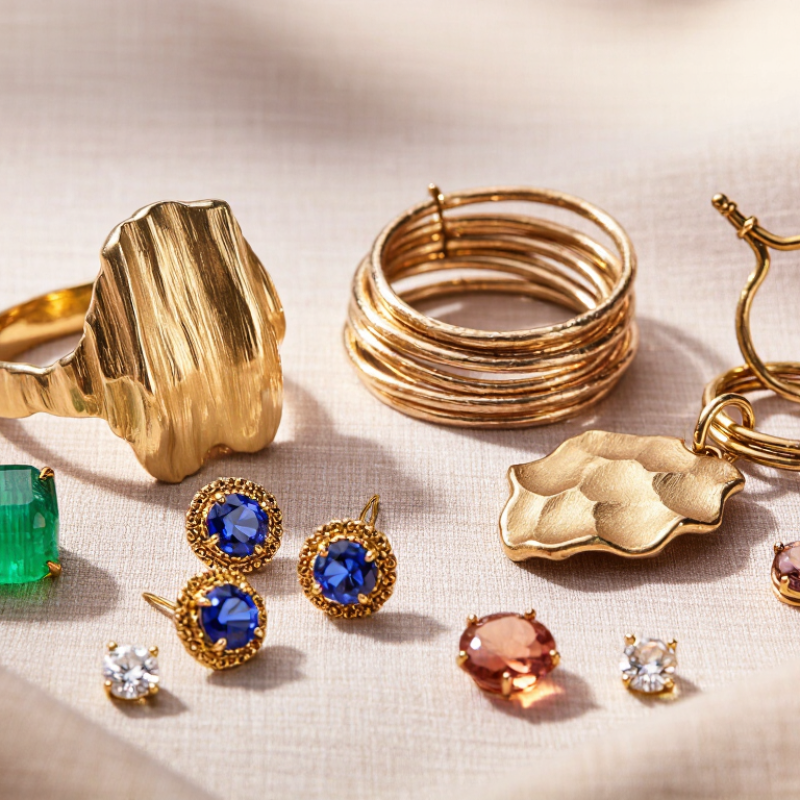
Defining handcrafted fine jewelry in 2026 means looking beyond a handmade label. True craftsmanship appears in the details: a softly rounded edge, a secure setting, and a polished surface that still shows careful bench work. Artisans increasingly combine sculptural forms with tactile textures, such as brushed gold beside bright, mirror-like sections. Recycled precious metals, traceable gemstones, and repairable construction also matter more to informed buyers. These choices connect beauty with accountability.
A handcrafted piece should have a clear material description and consistent finishing. Ask how the metal was formed, how the stone was set, and whether future repairs are possible. Tiny variations can prove human involvement, but they should not excuse weak construction. This distinction is sometimes overlooked. A slightly uneven texture may feel personal; a loose clasp is simply a problem. Professional makers inspect prongs, hinges, solder joints, and interior surfaces before delivery. Those checks support trust, especially when jewelry becomes an heirloom.
Tips: Examine the piece under natural light. Run a fingertip across its edges. Request metal purity details and gemstone documentation. Choose designs you can maintain, not only admire. I would also leave room for doubt: “handcrafted” can describe a small finishing step, not the entire creation. Ask precise questions before purchasing.
Key Materials and Craft Techniques Shaping New Designs
What Are the 2026 Top Handcrafted Fine Jewelry Trends?
In 2026, handcrafted fine jewelry will make materials visibly part of the design. Recycled gold, platinum, and traceable gemstones will support stronger purchasing decisions. The World Gold Council reported 1,877 tonnes of global jewelry consumption in 2024. High gold prices may encourage thinner forms, hollow construction, and carefully measured metal use. Every gram matters.
Craft studios are reviving granulation, hand engraving, pierced metalwork, and lost-wax casting. These techniques create uneven edges, subtle tool marks, and warmer surfaces. Hammered gold may replace perfectly polished finishes. Mokume-gane can produce wood-like patterns through layered metals. It feels tactile. Small irregularities can prove human involvement, although not every irregularity deserves praise.
The 2024 Jewelry Industry & Market Research Study by The Plumb Club surveyed more than 1,000 consumers. Its findings reinforce the value of personal meaning, wearability, and purchasing confidence. Designers may respond with modular earrings, convertible pendants, and signet forms sized for daily use. Recycled silver could appear beneath gold accents, while colored sapphires and spinel add controlled contrast. I may be overreading the sustainability shift. Certification still varies widely, and material claims need independent verification. That weakness remains important.
Leading 2026 Trends in Color, Form, and Texture
In 2026, handcrafted fine jewelry is moving toward expressive color, sculptural form, and touchable texture. In my studio experience, clients increasingly choose stones that feel personal rather than perfectly predictable. Deep moss green, smoky blue, muted coral, and warm champagne tones are gaining attention. These colors work beautifully with recycled gold tones and softly polished surfaces. Still, color should support the wearer, not overpower them.
Form is becoming more architectural, but comfort remains essential. Expect softened geometric earrings, uneven bands, open silhouettes, and pendants with gentle movement. Handcrafted pieces may show slight variation between matching earrings. That difference can add character. However, not every irregular edge represents artistry. Sometimes, it simply needs better finishing. Careful makers should test balance, clasp security, stone settings, and daily wear before presenting a piece as fine jewelry.
Tips: Combine one vivid stone with quieter metalwork. Try a textured ring beside a smooth band. Run a fingertip across the surface before buying. It should feel intentional, never sharp. Ask how the stone was set and how the piece can be maintained. A reliable jeweler should explain these details clearly. Think about your wardrobe, too. A dramatic form may look striking in photographs but feel less practical during a busy day.
What Are the 2026 Top Handcrafted Fine Jewelry Trends?
Leading 2026 Trends in Color, Form, and Texture
Saturated sapphire blue, ruby red, emerald green, and opalescent white are strong color directions for handcrafted fine jewelry. Sculptural gemstones support bold, organic forms, while pearls and opals introduce naturally tactile and iridescent textures. The chart compares representative materials by Mohs hardness, a factual indicator of everyday wear resistance rather than market share.
Hardness values are representative Mohs-scale ranges: diamond 10, sapphire 9, ruby 9, emerald 7.5–8, opal 5.5–6.5, and pearl 2.5–4.5.
The Rise of Personalized and Meaningful Fine Jewelry
What Are the 2026 Top Handcrafted Fine Jewelry Trends?
Personalized fine jewelry is moving beyond initials and birthstones. In 2026, buyers will seek pieces connected to specific memories, places, and family stories.
A hand-engraved date inside a ring can matter more than a larger gemstone. A tiny uneven mark may even show human touch.
McKinsey & Company and The Business of Fashion’s State of Fashion 2025 projects jewelry growth of roughly 4–6% annually through 2028.
This momentum reflects stronger interest in distinctive, emotionally relevant pieces. Customers increasingly ask about metal origin, gemstone sourcing, repair options, and production details. Clear answers build trust. Vague claims do not.
Bain & Company’s Luxury Goods Worldwide Market Study, Fall–Winter 2024, estimated the personal luxury goods market at about €363 billion in 2024, with a decline at constant exchange rates.
That pressure makes meaning more important than simple decoration. Artisans can respond with modular pendants, redesigned heirloom stones, and custom textures inspired by handwritten notes or coastal stones.
Personalization still has limits. Not every engraved phrase feels intimate. Some designs become crowded, expensive, or difficult to wear.
A thoughtful jeweler should challenge the brief when the result feels forced. That honesty may create a better piece.
Sustainable Practices Transforming Artisanal Jewelry Making
What Are the 2026 Top Handcrafted Fine Jewelry Trends?
Sustainable Practices Transforming Artisanal Jewelry Making
In 2026, fine jewelry will look less like decoration and more like documented material culture. Customers increasingly ask where metal was sourced, how stones were cut, and who was paid. That pressure is reshaping small workshops.
The World Gold Council’s Gold Demand Trends: Full Year 2024 reported an 11% yearly rise in recycled gold supply. This supports closed-loop production, but recycled metal is not automatically ethical. Artisans still need clear supplier records, separation controls, and honest environmental claims. A melted gold ring should not hide an unclear history.
Material efficiency is becoming practical, not fashionable. The United Nations Environment Programme’s Global Resources Outlook 2024 projects global resource extraction could rise 60% by 2060 without major changes. Handcrafted makers can respond with made-to-order pieces, repair services, and modular designs. A jeweler might reuse a client’s old chain, reshape it by hand, and preserve small scratches as visible history. Less waste, perhaps. Not no waste.
The Responsible Jewellery Council’s 2024 standards also emphasize supply-chain due diligence, human rights, and environmental management. These principles are influencing workshop routines, from safer chemical handling to documented stone suppliers. Yet sustainability can increase labor and verification costs. That uncomfortable reality deserves more attention. A smaller footprint may require a higher price, slower production, and fewer perfect options. Truthfully, many artisans are still learning how to measure impact beyond recycled content.
What Are the 2026 Top Handcrafted Fine Jewelry Trends? - Sustainable Practices Transforming Artisanal Jewelry Making
Evidence-based trend overview for sustainable artisanal fine jewelry
| Trend Area | Observed Industry Signal | Artisanal Jewelry Application | Sustainability Value | 2026 Outlook | Suggested Measurement |
|---|---|---|---|---|---|
| Recycled Precious Metals | Recycled gold and silver are established alternatives to newly mined metal and can be verified through chain-of-custody documentation. | Hand-forged rings, sculptural pendants, and small-batch pieces made with reclaimed metal. | Reduces dependence on additional mining and keeps existing precious metal in circulation. | Very High Expected to remain a core material choice for responsible fine jewelry. |
Percentage of total metal weight from recycled sources; supplier documentation available. |
| Traceable Gemstones | Consumers and regulators increasingly expect information about gemstone origin, treatment, and supply-chain handling. | One-of-a-kind pieces supported by mine-of-origin records, lapidary notes, and treatment disclosures. | Improves supply-chain accountability and helps distinguish documented stones from undocumented material. | Very High Traceability is likely to become a stronger purchase criterion in 2026. |
Share of gemstone inventory with origin, treatment, and supplier records. |
| Lab-Grown Diamonds | Laboratory-grown diamonds have the same crystal structure and chemical composition as mined diamonds, while their production route is different. | Custom-cut stones, asymmetric earrings, and larger center stones used in limited artisanal collections. | Can provide an alternative sourcing route, but environmental claims require transparent energy and production information. | High Demand is likely to favor documented origin and clearer impact disclosures. |
Origin disclosure rate; supplier energy and production documentation; independent grading report availability. |
| Reclaimed and Upcycled Materials | Circular design practices are expanding beyond metals to include salvaged beads, vintage components, and previously owned jewelry. | Reworked heirloom jewelry, mismatched earrings, remade brooches, and modular charm systems. | Extends material life, reduces waste, and preserves cultural or emotional value. | High Story-led, one-off designs should remain important in the handcrafted segment. |
Weight or unit count of reclaimed components used; percentage of collections designed for reuse. |
| Repairable and Modular Jewelry | Repair, resizing, refurbishment, and product longevity are central principles of a circular economy. | Replaceable earring parts, adjustable chains, resettable stones, and designs with accessible settings. | Extends product life and can reduce replacement purchases and material demand. | Very High Aftercare is expected to become part of the value proposition of fine jewelry. |
Repair policy availability; average repair turnaround; percentage of designs with replaceable components. |
| Low-Waste Craft Production | Small-batch production, made-to-order models, and material-efficient workshop processes help limit excess inventory and scrap. | Direct casting from reusable models, optimized cutting plans, and production only after confirmed orders. | Reduces unsold stock, material loss, packaging use, and unnecessary production. | High Made-to-order and limited-edition production should remain especially relevant for independent artisans. |
Material yield rate; workshop scrap recovered; percentage of products made to order. |
| Responsible Packaging | Packaging reduction, recyclable materials, and clear disposal guidance are increasingly connected with sustainable product design. | FSC-certified paper, reusable fabric pouches, minimal inserts, and plastic-free presentation boxes. | Reduces single-use packaging and improves the recoverability of post-purchase materials. | Medium-High Minimal, reusable packaging is likely to become a standard expectation rather than a novelty. |
Packaging weight per order; recycled or certified content; percentage of packaging designed for reuse or recycling. |
| Digital Product Passports | Digital traceability tools can connect an individual piece with material, repair, care, and provenance information. | QR-linked certificates for one-of-a-kind pieces, including metal source, stone details, maker information, and service history. | Supports transparency, resale, repair, authentication, and longer product use. | High Digital records are likely to grow as traceability and product-information requirements develop. |
Percentage of pieces with a digital record; completeness of material and care data. |
| Local and Fair Craft Partnerships | Responsible sourcing includes fair working conditions, transparent purchasing relationships, and recognition of skilled craft labor. | Collaborative collections with independent metalworkers, lapidaries, engravers, and traditional craft communities. | Strengthens artisan livelihoods, preserves technical knowledge, and can shorten portions of the supply chain. | High Human-centered provenance is expected to be a major differentiator for handcrafted jewelry. |
Percentage of production value paid to craft partners; documented labor and purchasing standards. |
| Timeless and Gender-Inclusive Design | Longer product use is supported by adaptable styling, personal expression, and designs that are not limited to seasonal gender categories. | Adjustable signet rings, sculptural pendants, convertible earrings, and stackable pieces with flexible sizing. | Encourages repeat wear and reduces disposal caused by short-lived style cycles or limited usability. | Medium-High Versatile, durable, and personal designs should continue to outperform highly disposable styling. |
Number of styling configurations; resizing capability; repair and wear-life feedback. |
Related Posts
-
Top 10 Handcrafted Fine Jewelry Suppliers in China
-
How to Choose Bridal Jewelry for Global Buyers?
-
Top 10 Unique Handcrafted Jewelry Pieces You Should Own?
-
Top Designs in Jewelry That Will Elevate Your Style?
-
Top 10 Trends in Mens Jewelry You Should Know About?
-
Top Tips for Sourcing Handcrafted Jewelry Worldwide