Blog
Who Are the Top Diamond Jewelry Suppliers in China?
China is a major center for jewelry manufacturing, but finding a suitable diamond jewelry supplier takes more than comparing prices. Buyers need to assess stone documentation, workmanship, production capacity, and communication. A polished showroom sample is useful. It is not proof of consistent bulk quality.
Industry reports offer context, though their figures require careful reading. China’s National Bureau of Statistics reported that retail sales of gold, silver, and jewelry rose 13.3% in 2023. This broad category includes products beyond diamond jewelry, so it should not be treated as a diamond-specific growth rate. Bain & Company and the Antwerp World Diamond Centre’s Global Diamond Industry Report 2023 also examined market pressures, including changing demand and supply-chain challenges. Together, these sources show why supplier selection should account for both market conditions and verifiable product information.
This guide examines leading Chinese suppliers through practical criteria: documented diamond specifications, quality-control procedures, customization options, export experience, and responsiveness. Where available, buyers should request current certificates, production details, and sample pieces before placing larger orders. Small checks matter. Supplier rankings can be helpful, but they are not independent audits. Factory capacity and sourcing practices may change, and public information does not always reveal those changes. Use the profiles as a starting point, then verify each company’s claims directly.
China’s Diamond Jewelry Supplier Industry at a Glance
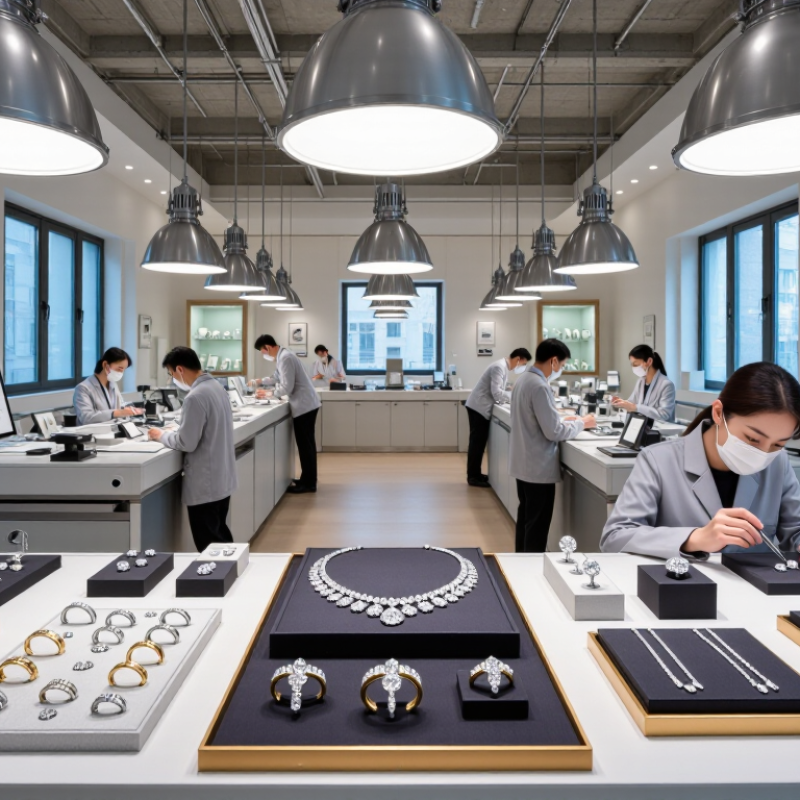
China’s diamond jewelry supply industry brings together design studios, casting workshops, stone-setting teams, and export-focused manufacturers. Shenzhen and Guangzhou are notable production and trading centers, with nearby specialist suppliers supporting different stages of production. Some factories handle a piece from CAD drawing to final inspection; others rely on local partners for setting or finishing. The distinction affects lead times and accountability.
For buyers, useful questions go beyond price. Ask how diamond identity and grading documents are checked, what metal specifications appear on invoices, and how finished pieces are inspected under magnification. Request close-up photographs of prongs, clasps, and hallmark areas, not only polished catalog images. Small details matter. A supplier’s written tolerance for stone size, color, and setting alignment can prevent avoidable misunderstandings.
The industry offers flexibility in custom design and production runs, but quality can vary between workshops. A sample may look excellent while later batches show uneven prongs or inconsistent polish. That is worth acknowledging: no brochure replaces a sample review and clear inspection criteria. Buyers should also confirm who handles repairs, packaging, and shipping documentation before placing larger orders. These steps create a more reliable picture than a low quotation alone.
Global Rough-Diamond Production Relevant to China’s Jewelry Supply Chain
Leading producing countries, 2022 (million carats)
China’s diamond jewelry suppliers operate within a global supply chain. These figures show mine production by country—not Chinese supplier output or the sourcing share of any supplier. Source: Kimberley Process rough diamond production statistics, 2022.
Types of Diamond Jewelry Suppliers in China
China’s diamond jewelry suppliers generally fall into several practical categories. Manufacturers operate workshops or factories and handle design, stone setting, polishing, and production. They suit buyers seeking repeat orders or custom specifications. Ask whether stone sourcing and final inspection happen in-house. Not every supplier controls every stage.
Wholesalers hold ready-made stock, such as stud earrings, pendants, and tennis bracelets. They can offer quicker sampling and smaller selections for comparison. Check stone measurements, metal fineness, and workmanship under clear lighting. Details matter. A written specification makes it easier to compare similar pieces and spot unexpected differences.
Specialist workshops focus on custom or small-batch pieces, while trading and export companies coordinate orders across multiple producers. For a center stone, request its grading documentation and confirm that the report matches the stone supplied. A polished sample can still differ from bulk production. I would review a pre-shipment sample and agree on inspection criteria before placing a large order. That takes time. It can also reveal weak prongs, uneven settings, or clasp problems that photographs miss. Not always. A smaller supplier may communicate well but have limited production capacity, so verify timelines against a realistic sample order.
Who Are the Top Diamond Jewelry Suppliers in China? - Types of Diamond Jewelry Suppliers in China
| Supplier Type | Typical Scope | Often Suited To | What to Verify |
|---|---|---|---|
| Diamond jewelry manufacturers | Produce finished pieces and may handle processes such as casting, stone setting, polishing, and quality control. | Retailers and wholesalers seeking repeat production or private-label jewelry. | Which production steps are performed in-house, minimum order quantities, sample approval, and inspection procedures. |
| OEM and ODM suppliers | OEM suppliers make products to a buyer’s specifications; ODM suppliers may also provide designs or product-development support. | Brands developing custom collections or manufacturing designs to supplied specifications. | Design ownership, confidentiality terms, CAD and sample approval stages, and responsibility for tooling costs. |
| Diamond wholesalers | Supply diamonds or finished diamond jewelry in wholesale quantities; product range and stock availability vary by supplier. | Buyers who need ready-to-order goods or access to diamond inventory. | Stone specifications, whether grading reports are provided, return terms, and whether listed items are in stock. |
| Natural diamond specialists | Focus on jewelry set with mined diamonds and may offer selection by the 4Cs: carat weight, color, clarity, and cut. | Buyers specifically sourcing jewelry with natural diamonds. | Natural-origin disclosure, matching of reports to stones, and clear grading and disclosure practices. |
| Laboratory-grown diamond specialists | Supply jewelry set with laboratory-grown diamonds, which have the same basic crystal structure as natural diamonds but a different origin. | Buyers seeking laboratory-grown diamond options and explicit origin disclosure. | Clear identification as laboratory-grown, stone documentation where applicable, and separate pricing and product descriptions from natural diamonds. |
| Custom jewelry workshops | Create made-to-order pieces from sketches, reference images, or digital design files; capabilities and order sizes vary. | One-off designs, small collections, and customized settings or dimensions. | Prototype and revision costs, production lead time, metal specifications, and final-product tolerances. |
| Export-oriented suppliers and trading companies | Coordinate sourcing, orders, and export logistics; some act as intermediaries rather than operating their own factory. | Overseas buyers who need support coordinating orders and shipment documentation. | Whether the supplier is the manufacturer or an intermediary, product traceability, shipping terms, and export documentation. |
Supplier categories can overlap. A grading report describes a particular diamond; it does not by itself verify the supplier or the finished jewelry.
How to Evaluate Leading Chinese Suppliers
Evaluating a leading Chinese diamond jewelry supplier takes more than reviewing a polished catalog. Ask how the team sources stones, checks metal purity, and records production steps. Request documentation suited to the specific stones and finished pieces, then confirm that details match your order. A sample can reveal uneven prongs, rough edges, or a clasp that feels weak.
Small details matter.
Discuss how defects are handled and ask for clear inspection criteria before production begins. If possible, compare the sample with the final item under neutral lighting.
Reliable suppliers answer specific questions with consistent evidence. Ask for recent quality-control records, production timelines, and written terms for revisions, packaging, and shipping. A video call can help you observe the workshop process, but it is not a substitute for independent checks.
Review communication as carefully as craftsmanship: do replies address measurements, stone specifications, and tolerances directly? A tidy audit file is useful, yet it may not show every production weakness. I would not treat one successful sample as proof of long-term consistency. Consider a small trial order, document any differences, and assess how the supplier responds when something needs correction.
Notable Diamond Jewelry Suppliers and Their Specialties
China’s diamond-jewelry suppliers often specialize by production stage, not just by city. Shenzhen workshops are known for design development, CAD modeling, and small-batch sampling. Guangzhou and Panyu manufacturers commonly handle casting, stone setting, polishing, and export orders. Some suppliers focus on bridal solitaires, while others make pavé bands, lightweight everyday pieces, or custom collections. Details matter. A supplier’s strength shows in consistent setting quality and dependable lead times, not just a polished showroom.
Bain & Company’s 2023 Global Diamond Industry Report estimated worldwide diamond-jewelry sales at about US$84 billion in 2022, up 3% year over year. That market scale rewards capable vendors, but it does not prove any individual factory’s quality. Request current grading documents for center stones, written metal specifications, close-up setting photos, and pre-shipment inspection records. Samples can deceive. Production quality may vary.
Tips: Compare the same design across suppliers. Ask how they control stone matching, finishing, and delivery schedules. A clear answer is useful; vague promises deserve a second look.
Sourcing and Verifying a Chinese Diamond Jewelry Supplier
Who Are the Top Diamond Jewelry Suppliers in China?
Sourcing and Verifying a Chinese Diamond Jewelry Supplier
A reliable supplier should be judged by evidence, not polished photos or fast promises. Request a business profile, workshop details, and a clear description of which production steps happen in-house. Ask how diamond quality is documented, including grading reports where applicable. Small details matter.
Start with a written product specification. Record metal purity, stone shape, dimensions, setting style, and acceptable weight variation. Then order a sample and inspect it under neutral light. Check prong alignment, clasp movement, finish, and whether the delivered piece matches its specification. Ask for close-up images of any repairs or quality issues. A sample is useful, but it cannot prove every future batch will be identical.
Before placing a larger order, clarify inspection procedures, production timing, packaging, and how defects are handled. Request recent quality-control records and verify important claims through independent documentation when possible. Ask for a video call from the production area, or arrange an in-person visit if practical. Ask for evidence. Be cautious if answers keep changing or documents lack consistent details. I would not treat one successful sample as a guarantee; that assumption is easy to make and hard to undo. Keep communication in writing, and confirm specifications again before production begins.
Related Posts
-
Top Designs in Jewelry That Will Elevate Your Style?
-
Best Personalized Jewelry for Women 2026?
-
What is Women's Bridal Jewelry and How to Choose the Perfect Pieces
-
How to Choose the Perfect Engraved Jewelry for Every Occasion?
-
Best Engraved Jewelry Ideas for Every Occasion?
-

Top 10 Dallas Jewelry Stores for Stunning Accessories and Unique Finds?