
Skip to Content
chevron-left chevron-right chevron-up chevron-right chevron-left arrow-back star phone quote checkbox-checked search wrench info shield play connection mobile coin-dollar spoon-knife ticket pushpin location gift fire feed bubbles home heart calendar price-tag credit-card clock envelop facebook instagram twitter youtube pinterest yelp google reddit linkedin envelope bbb pinterest homeadvisor angies

Top Number Patches Suppliers for Global Buyers?

Finding reliable Number Patches suppliers can feel simple until a real order begins. Product photos rarely show every important detail. Buyers must examine thread density, edge finishing, backing strength, color accuracy, and wash resistance. A small patch may contain dozens of production decisions.

This guide evaluates leading suppliers for global buyers through practical purchasing criteria. It considers customization options, sample procedures, minimum order quantities, communication quality, production capacity, and delivery reliability. It also looks at embroidery clarity on small lettering, hook-and-loop performance, heat-seal consistency, and packaging protection. These details matter when patches must arrive ready for uniforms, clubs, workwear, or branded merchandise.

Supplier credibility deserves equal attention. Experienced manufacturers should provide clear specifications, realistic timelines, material information, and quality-control evidence. Buyers should request samples before approving large quantities. A supplier that answers quickly is useful, but dependable records matter more. Ask how defects are inspected and how replacements are handled.

No supplier ranking is perfect. A factory strong in bulk embroidery may not suit small custom orders. A low quotation may also exclude sampling, packaging, or shipping costs. That is easy to miss. I would treat each supplier as a starting point, not a final decision. Comparing physical samples, written quotations, and production updates can reveal differences that polished websites conceal. This approach helps global buyers choose with greater confidence and fewer costly surprises.
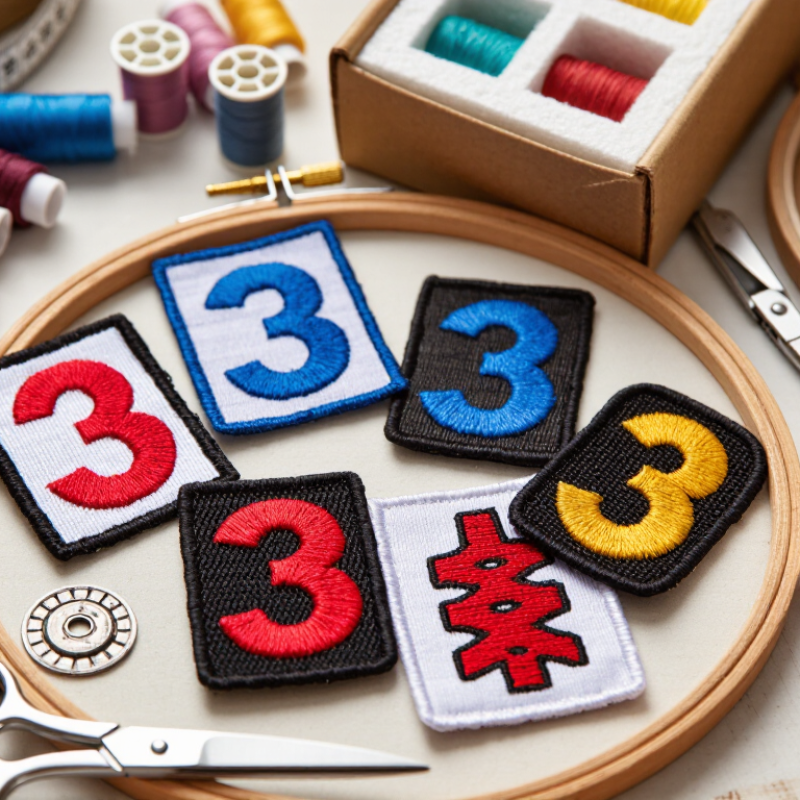
Top Number Patches Suppliers for Global Buyers?

What Are Number Patches and How Are They Used?

Number patches are fabric badges carrying digits, symbols, or short number sequences. They identify players, teams, uniforms, product batches, and workplace roles. Common formats include embroidered twill, printed fabric, heat-seal patches, and hook-and-loop designs. Each format suits a different use.

Global buyers should match the patch structure with its working environment. Sew-on patches suit repeated washing and heavy movement. Heat-seal patches create a clean finish on suitable fabrics. Hook-and-loop patches support frequent replacement, but their edges need strong stitching.

A 2024 Materials Market Report from Textile Exchange recorded polyester at about 57% of global fiber production. Recycled polyester represented roughly 14%. This matters when buyers request lower-impact backing fabrics or threads.

Quality checks should cover numeral accuracy, edge cutting, color consistency, adhesion, and wash performance. A clear sample is useful. It is not enough. I would request production samples, wash them, and inspect curling around the edges. Suppliers should provide material details, size tolerances, artwork approval, and packaging records. The International Trade Centre’s trade data also shows how widely manufactured textile goods move across borders, making consistent specifications essential for international orders. Small mistakes can multiply across thousands of patches. Supplier selection should therefore consider communication speed, sampling discipline, production capacity, and documented inspection practices, not only price.

Key Criteria for Evaluating Global Number Patch Suppliers

For global buyers, evaluating number-patch suppliers starts with repeatable quality, not a polished catalog. Textile Exchange’s Materials Market Report 2024 estimates global fiber production reached 124 million tonnes in 2023. That scale increases sourcing choices, but not consistency. Ask for pre-production samples showing stitch density, edge finishing, backing adhesion, and color under daylight. Small details matter. A number “8” should keep its shape after washing, folding, and repeated handling.

The ISO Survey 2023 recorded more than 1.2 million ISO 9001 certificates worldwide, yet certification alone proves little about patch workmanship. Request lot-level inspection records, thread controls, rework rates, and documented corrective actions. Confirm whether the factory measures dimensions with calibrated tools. For embroidered patches, test wash durability and thread colorfastness using recognized textile methods. For printed versions, check abrasion, cracking, and transfer resistance. Ask for actual results, not promises.

Lead time should include sampling, approval, production, and export handling. Compare landed cost, not unit price. Verify minimum-order flexibility and capacity during seasonal peaks. UNCTAD’s Handbook of Statistics 2024 shows global merchandise trade remains exposed to freight and demand shifts. Delays can quickly change a cheap order. I have seen buyers overlook packaging. Count pieces, protect sharp edges, and label cartons clearly. I would still keep a second qualified source. Supplier data can look complete, but one unresolved defect deserves a pause.

Leading Number Patch Suppliers for International Buyers

Leading Number Patch Suppliers for International Buyers should offer more than attractive samples. They need stable stitching, clear sizing, and reliable export procedures. Grand View Research reported that the global embroidery market was valued at over USD 2 billion in 2023, with continued growth expected through 2030. This expansion increases supplier choice, but also raises quality risks.

Look closely.

Experienced buyers should request pre-production samples, thread specifications, wash-test results, and production photographs. A dependable supplier can explain stitch density, backing materials, edge finishing, and color matching without vague promises. AATCC testing methods can help evaluate colorfastness and dimensional change after washing. These details matter when patches are applied to uniforms, sportswear, or outdoor garments.

International orders also require practical control. The World Trade Organization continues to identify transport efficiency and customs procedures as major influences on global trade costs. Ask suppliers about carton labeling, commercial invoices, HS-code support, and delivery terms. Low minimum quantities sound helpful, but they may increase unit costs and weaken consistency between batches. That is often overlooked. Buyers should compare landed cost, not only factory price. Some suppliers communicate quickly before payment, then respond slowly during production. A written approval process, inspection point, and documented tolerance range can reduce that risk. No supplier is perfect, including highly experienced ones; honest corrective action is more valuable than flawless marketing.

Top Number Patch Supplier Hubs for Global Buyers

Country-level logistics performance provides a practical, brand-neutral proxy for international sourcing readiness. The 2023 scores range from 1 to 5, with higher values indicating stronger logistics performance.

China, India, Türkiye, and Vietnam show comparatively strong logistics readiness among established apparel and textile manufacturing hubs. Logistics performance is only one screening factor; buyers should also evaluate patch quality, minimum order quantities, production capacity, compliance, and delivery terms.

Comparing Materials, Customization, Pricing, and Production Capacity

Top Number Patches Suppliers for Global Buyers

Number patch suppliers differ sharply in material control, customization, pricing, and production capacity. Embroidered patches offer texture and a familiar retail appearance. Woven patches provide finer details on small numbers. Rubber-like materials resist moisture, but they may feel less flexible. Recycled polyester can support sustainability goals, though color matching may require extra testing. Ask for physical samples before approving bulk production. A digital proof is not enough.

Customization usually covers size, border style, backing, thread color, and attachment method. Confirm the actual number height, because tiny digits can lose clarity after stitching. Reliable suppliers should explain artwork limits and sample revisions clearly. Pricing depends on quantity, material, stitch density, mold requirements, packaging, and delivery terms. Request a complete quotation, not only a unit price. Cheap offers can hide setup fees or weak quality checks. Production capacity also matters during seasonal demand. Ask for monthly output, current lead time, inspection procedures, and backup equipment. A supplier may promise fast delivery, yet capacity figures sometimes lack evidence. I would request recent production photos and a small trial order. Even then, mistakes remain possible.

Top Number Patches Suppliers for Global Buyers? - Comparing Materials, Customization, Pricing, and Production Capacity

Supplier Profile Primary Materials Customization Options Typical Unit Price* Typical MOQ Monthly Capacity Range Standard Lead Time Best-Fit Applications Quality and Compliance Indicators
High-Volume Embroidery Factory Polyester twill, cotton twill, felt, embroidery thread, heat-seal backing Custom numbers, fonts, borders, merrowed edges, metallic thread, hook-and-loop backing, iron-on backing US$0.18–0.75 per piece 100–500 pieces per design 300,000–1,500,000 pieces 7–15 working days after artwork approval Sports uniforms, team apparel, workwear, school clothing Colorfastness testing, pre-production sample approval, needle and thread inspection, batch-level QC records
Premium Chenille Specialist Acrylic or rayon chenille yarn, felt, satin, twill, embroidered details Raised chenille numbers, mixed textures, layered construction, custom edging, sequins, metallic yarn US$0.80–3.50 per piece 50–200 pieces per design 30,000–150,000 pieces 15–30 working days after sample approval Varsity jackets, premium sportswear, fashion garments, souvenir apparel Yarn density inspection, edge uniformity checks, dimensional tolerance control, wash-test sampling
PVC and Silicone Patch Producer Soft PVC, silicone rubber, flexible TPU, adhesive or hook-and-loop backing Two-dimensional or three-dimensional numbers, multiple colors, matte or gloss finish, embossed details, glow or reflective effects US$0.25–1.80 per piece 100–500 pieces per design 100,000–600,000 pieces 12–25 working days including mold preparation Outdoor clothing, tactical gear, bags, caps, motorcycle apparel Material composition declaration, migration testing where required, pull-strength testing, surface-finish inspection
Heat-Transfer Number Manufacturer PU film, PVC film, flock film, reflective film, printable transfer media Variable names and numbers, gradients, reflective surfaces, flock texture, metallic finishes, low-temperature application options US$0.08–0.60 per number 50–300 pieces per design 500,000–3,000,000 numbers 3–10 working days after digital proof approval On-demand personalization, sports tournaments, retail apparel, promotional clothing Peel and wash testing, application-temperature guidance, adhesion testing, print-registration inspection
Woven Label and Number Supplier Woven polyester, recycled polyester, cotton label tape, heat-seal adhesive Fine lettering, small numbers, high-density weaving, folded edges, sew-on or heat-seal backing US$0.06–0.35 per piece 500–1,000 pieces per design 1,000,000–5,000,000 pieces 5–14 working days after artwork approval Fashion labels, casualwear, underwear, lightweight sports garments Thread-density checks, color standard matching, fray inspection, dimensional and wash testing
Recycled-Material Patch Supplier Recycled polyester felt, recycled PET fabric, organic cotton twill, water-based inks Embroidered, printed, woven, laser-cut, stitch-border, recycled backing and packaging options US$0.25–1.40 per piece 200–1,000 pieces per design 80,000–400,000 pieces 15–28 working days after material confirmation Sustainable fashion, outdoor brands, corporate uniforms, eco-conscious merchandise Recycled-content documentation, restricted-substance testing, traceability records, packaging-material declarations
Small-Batch Custom Workshop Twill, felt, cotton, polyester, faux leather, embroidery thread, printed films Low-volume mixed designs, sample revisions, individualized numbering, varied shapes, multiple backing types US$0.60–4.50 per piece 10–50 pieces per design 5,000–40,000 pieces 7–20 working days depending on complexity Prototype development, creator merchandise, club apparel, limited editions Visual inspection, sample sign-off, stitch-density review, buyer-specific quality checklist
Integrated Apparel Trims Manufacturer Embroidered patches, woven labels, printed transfers, PVC, silicone, woven and knitted fabrics Multi-product sourcing, coordinated color standards, packaging, barcode labels, kitting and garment-set packing US$0.12–2.80 per piece 300–2,000 pieces per design 250,000–1,000,000 pieces 20–40 working days for combined orders Large apparel programs, uniform contracts, retail replenishment, global sourcing projects AQL-based inspection, production-line controls, social-compliance audit capability, export documentation support

*Indicative bulk price ranges in USD for standard-size number patches, excluding tooling, sampling, freight, duties, special packaging, and expedited production. Final pricing depends on size, stitch density, number of colors, backing type, artwork complexity, order quantity, and destination.

How to Select and Work With the Right Global Supplier

Choosing the right number patches supplier starts with the product, not the lowest quotation. Check stitch density, edge finishing, backing strength, and color consistency on a physical sample. A number should remain readable from a few meters away. Ask for production photos, material details, and documented quality procedures. Clear evidence matters more than polished promises.

A reliable global supplier should explain minimum order quantities, sample fees, lead times, packaging, and shipping terms in plain language. Request a pre-production sample before approving bulk work. Measure the patch, inspect the thread tension, and test the backing on the intended fabric. Small details often reveal larger process problems. Communication speed also matters, especially across time zones. Use written specifications, revision records, and agreed inspection points.

Do not judge a supplier from one attractive sample. It may represent their best work. Compare several batches when possible, and ask how they handle defects, delays, and replacement requests. Ethical sourcing requires transparent materials, safe workplaces, and accurate customs documentation. A factory audit or independent inspection can add confidence, though neither removes every risk. I would leave a reasonable buffer for seasonal delays; tight schedules often create avoidable pressure. The first order should stay manageable. Trust is earned through repeatable results, not a single successful delivery.

Article Source:

Stay tuned, more blog items coming soon!

Have a Custom Design in Mind?